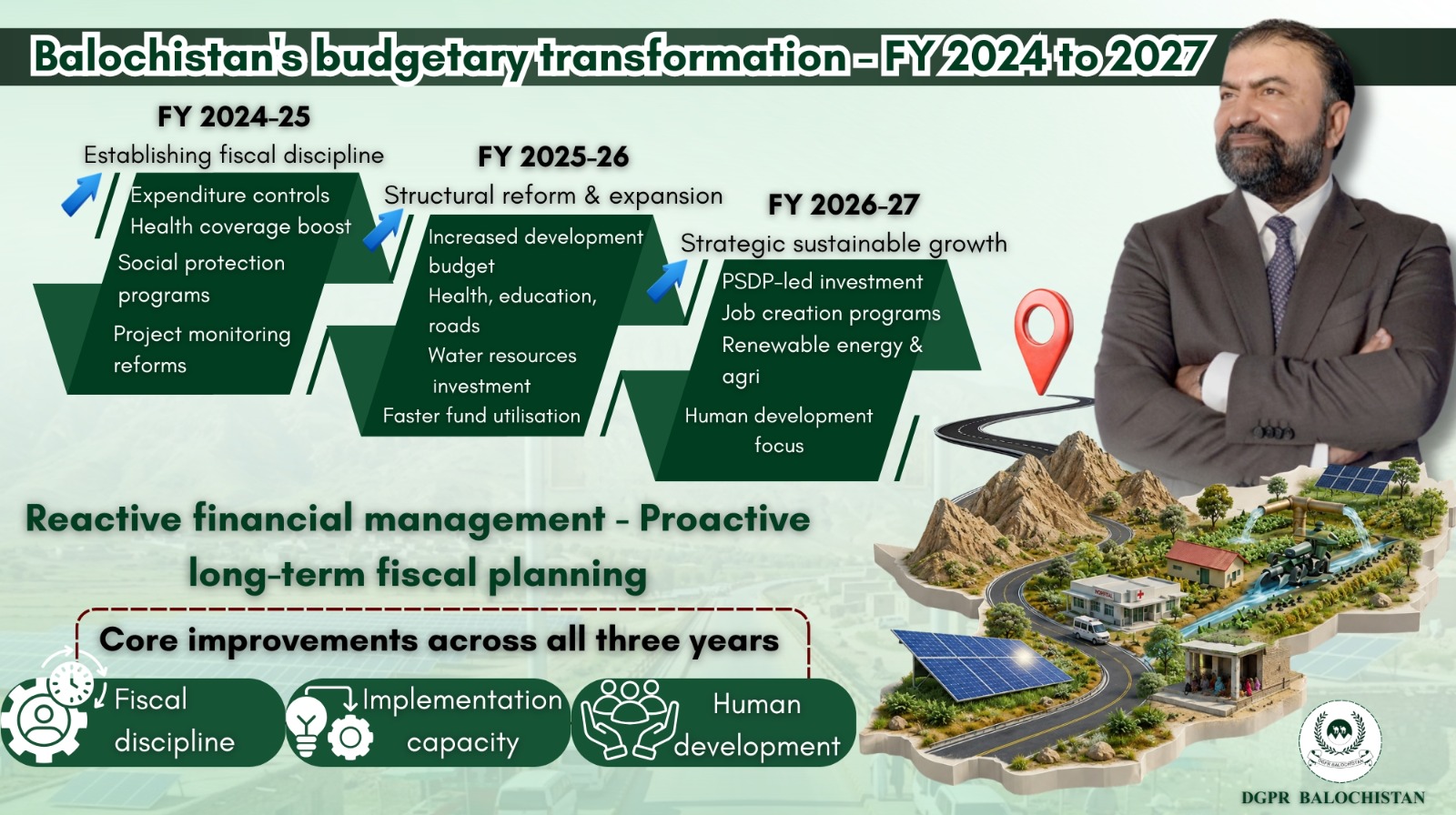
Over the past three fiscal years, Balochistan has undertaken a gradual yet significant transformation in its approach to public financial management. Moving beyond short-term fiscal management, the provincial government has adopted a more strategic and development-orientated budgeting framework that prioritises fiscal sustainability, institutional reforms, and improved public service delivery.
The budgets for FY 2024–25, FY 2025–26, and FY 2026–27 have been designed with a clear vision of moving beyond reactive financial management towards proactive, long-term fiscal planning.
The provincial government has come to view the annual budget process as a policy-making process to improve service delivery, enhance infrastructure, create economic opportunities and rebuild public trust in governance rather than simply an accounting process. There are still hurdles to clear, but the direction is promising: a government that is intent on making fiscal policy more development-orientated.
FY 2024–25: Establishing Fiscal Discipline
The FY 2024-25 budget was the first step in a larger reform initiative to achieve fiscal stability. Pakistan, in a period of economic uncertainty and increased expenditure pressures on governments, implemented a prudent but development-friendly fiscal policy in Balochistan.
The government ensured fiscal discipline through enhanced expenditure control, public expenditure reduction and safeguards of development spending amidst constrained financial resources. Greater focus was given to building up health coverage, enlarging social protection programmes and basic infrastructure in low-performing districts.
Administrative changes were also initiated to tackle previously identified shortcomings on project planning and financial controls during this period. Stepping towards a better framework for public investment management includes more rigorous oversight of development schemes, more robust monitoring practices and a push to speed up the fund utilisation.
FY 2025–26: The Expansion of Development Through Structural Reforms
The FY 2025-26 year demonstrated an increased sense of confidence in the financial efforts, building on the previous reforms. With better revenue management and better expenditure control, the government was able to make more allocations to the development budget without sacrificing fiscal responsibility.
The focus of the budget was on investing in health, education, road networking, water resources and social welfare. Much effort was focused on strengthening institutional capacity to carry out development projects more effectively and enhancing public service delivery.
The most important administrative improvement during this period was the improved use of development funds. In the past, a significant share of the development budget has been left unspent because of delays in procurement, lack of coordination and administrative bottlenecks. The province significantly boosted the implementation of projects through tighter project monitoring, better planning processes and increased accountability of its departments.
These changes have helped to increase the financial effectiveness of the budget and greater public confidence that funding would result in increasingly substantive development results.
FY 2026–27: Strategic Budgeting for Sustainable Growth
This is a matured version of the budgetary strategy and is reflected in the FY 2026-27 budget. The current government has taken a more inclusive and holistic approach, incorporating financial planning along with long-term socio-economic development, rather than just annual spending.
The budget has a large share dedicated to building up healthcare systems, education infrastructure, social safety programmes and infrastructure development throughout the province. The concept of human development has become ingrained in fiscal planning – and it is increasingly recognised that sustainable economic growth relies on investment in people as well as investment in physical capital.
The Provincial Sector Development Programme (PSDP) is the major instrument to realize these goals. PSDP funds are allocated to strategic investments in transport networks, water supply systems, healthcare facilities, education, irrigation infrastructure and projects on regional connectivity. The government’s focus on long-term, economically and socially beneficial projects will help to narrow regional gaps and boost local economies.
Another important component of the FY 2026-27 budget is its keen interest and focus on job creation, overcoming obstacles and becoming a more people-centric budget. With the establishment of new jobs, especially in the education sector and health sector, the problem of service provision is solved as well as the unemployment problem. The recruitment aims to boost public institutions as well as enhance quality health and education services across the province.
The budget also encourages economic self-reliance by focusing specific programmes on solar-powered agricultural tube wells, assistance for renewable energy, financial inclusion and local banking infrastructure. These efforts aim to lower production expenses, increase access to funding, improve rural livelihoods, and foster environmentally friendly economic growth.
Improving Development Fund Mobilization and Utilization
The shortage of funds was one of the fundamental problems of the development programmes of Balochistan, but their effective use was another. Even though there was adequate provision of funds, administrative delays, lack of coordination between departments, technical ability deficits and length of procurement processes frequently led to low expenditure on development.
The above challenges have been addressed in a structural and administrative way in recent years, and there is hope for an improvement. Improved project appraisal processes, improved financial monitoring, more accountability for departments and more efficient approval procedures have hastened project implementation. Thus, development funds have been transformed increasingly into finished infrastructure, improved public services and measurable development results.
It represents a major institutional improvement and a reminder that good governance is not just about the allocation of resources but also the timely and transparent implementation of those resources.
Aligning Fiscal Policy with Human Development
An important characteristic of Balochistan’s recent budgets is the growing integration of fiscal planning with human development objectives.
The appreciation of the linkages between economic growth and improvements in health, education, employment, social protection, and rural livelihoods is reflected in budgetary choices. The links between economic growth and improving health, education, employment, social protection and rural livelihoods are increasingly reflected in budgetary decisions.
The province’s development philosophy is put into practice through the provision of more funds for hospitals, schools, technical education, clean drinking water, renewable energy, agricultural modernisation and job creation and is aimed at enhancing the quality of life for its citizens and building its long-term economic security.
The government has moved away from individual development projects to increasingly consider an integrated approach that combines infrastructure provision with service delivery, the development of economic opportunities and social inclusion.
Conclusion
The fiscal policy of Balochistan has shifted from short-term financial management to a more strategic and development-oriented approach in the three budget cycles (FY 2024–25, FY 2025–26, and FY 2026–27). Structural reforms have increased fiscal discipline, better allocation of development fund resources, better implementation of projects, and increased investment in key areas of public services.
The progress is good, but full success won’t be judged by budget allocations. These reforms will truly be seen in improved healthcare facilities, enhanced education results, robust infrastructure, increased employment, improved agriculture productivity and tangible improvements in the daily lives of the people of Balochistan.
Preserving fiscal discipline, implementation capacity and transparency in governance will continue to be vital in the province’s desire to turn financial planning into a long-term socio-economic shift.