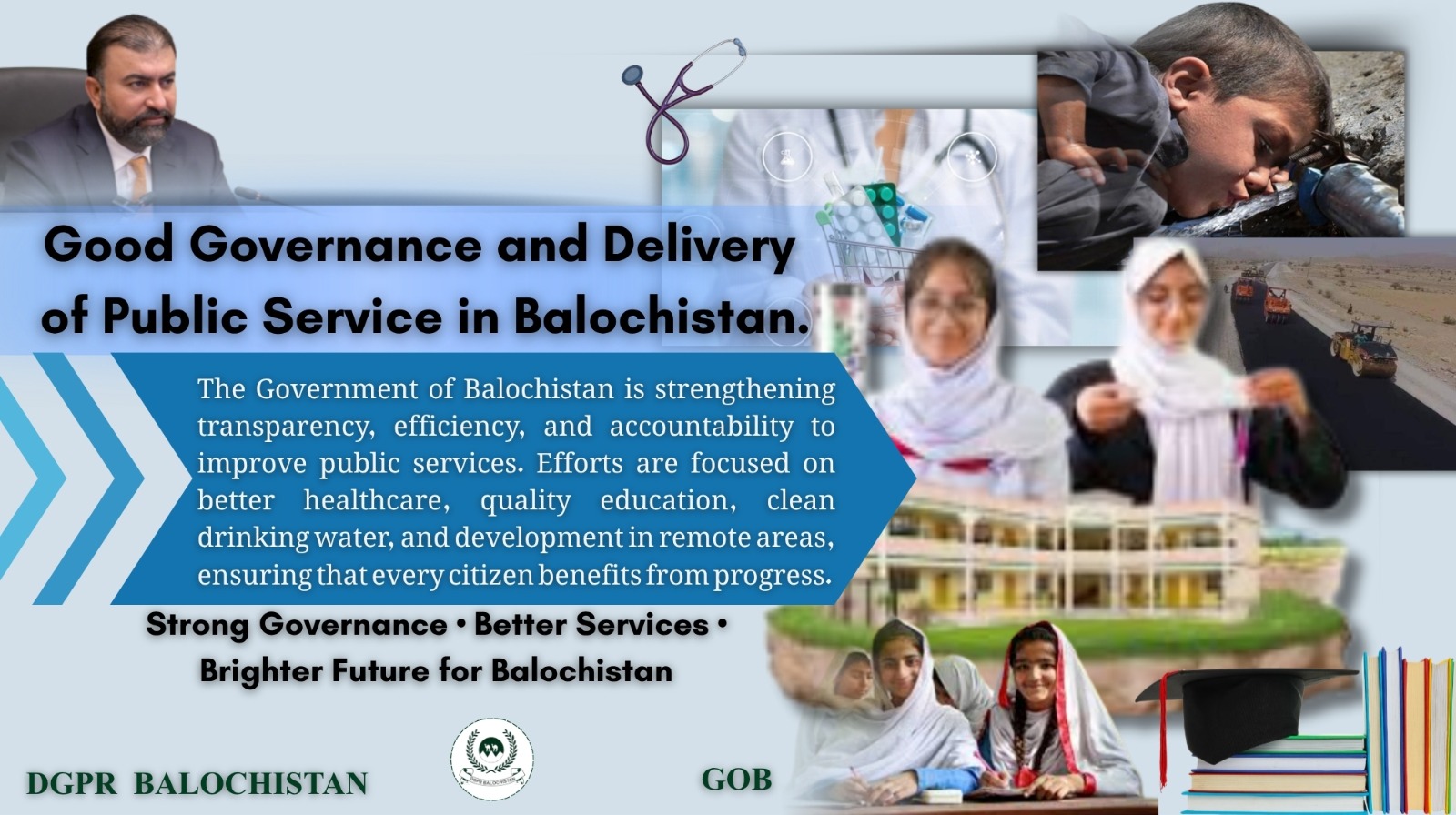
Balochistan has always been known in terms of governance and inefficiencies in the delivery of services because of its huge geographical area, the scattered population, and the poor infrastructure. Nevertheless, with the government of Balochistan under the leadership of Chief Minister Balochistan Mir Sarfraz Bugti, there has been a holistic reform agenda that is intended to transform the current situation of public service delivery into an efficient, transparent and people-centric system.
The province is currently experiencing a slow but quantifiable change – from administrative inertia to performance-based governance.
Reforms based on Governance and Accountability
One of the pillars of the present government strategy is the enhancement of governance by providing accountability and monitoring measures. Reforms in administration have greatly enhanced the performance of institutions, especially in education and health sectors.
The recent statistics indicate that the complaints about absent teachers and doctors have decreased to less than one per cent, which is a significant change due to close supervision and administrative control.
Moreover, the government has standardised citizens’ participation by establishing 412 open courts (Khuli Kachehris) in each of the 36 districts, which have responded to 3,675 citizen complaints about service delivery.
This first-hand approach to engagement makes governance not limited to offices but extending to the people at their doorstep.
Healthcare Reforms: increasing access to the last mile
Healthcare has been a top priority, with a clear focus on restoring functionality and access.
- 164 dormant Basic Health Units (BHUs) around the province have been operationalised. (Daily Lead Pakistan)
- The facilities are now able to provide services to over 1.2 million patients annually, particularly in the rural and underserved areas. (Daily Times)
Digital monitoring systems are used to offer performance, real-time monitoring and transparency. (health.balochistan.gov.pk) In addition, the government has conducted massive human resource empowerment:
- Hiring 1,600 doctors and 1,600 paramedics and more is being done. (Balochistan Pulse)
These programmes are indicators of the shifting trend toward service-based healthcare provision rather than infrastructure building, whereby facilities are not simply built but put into service.
Education Sector: Greater Access and Less Exclusion
In the education sector, focused interventions are bearing tangible outcomes.
- The out-of-school children percentage has declined by 14 per cent, falling to 45 per cent. (UrduPoint)
The advancement is indicative of targeted policies, including:
- School reforms and reopening programs.
- Teacher attendance check.
- District-wide enrolment drives.
The government is serious about it: the government must ensure every school is functional and every child has the opportunity to be educated.
Digital Change to Smart Governance
The reforms being pursued include the use of technology in governance.
The government of Balochistan has initiated the following:
- The Balochistan Statistics Dashboard is capable of accessing the data in real time and planning the policies.
- Automated PSDP development projects are monitored.
- Financial systems online in terms of budgeting, billing and tracking of expenditures (https://www.dailyindependent.com.pk)
These are contributing to efforts:
- Evidence-based decision-making.
- Reduced delays and leakages.
- Improved transparency and accountability.
This is a move towards conventional governance and intelligent governance which is informed by data. Decentralisation: Services to the People.
The government has been keen on the issue of decentralisation due to the difficulties of distance and accessibility.
The Chief Minister Mir Sarfraz Bugti has instructed district administrations to solve their problems at the local levels so that citizens do not have to travel to Quetta to access basic services.
This approach strengthens:
- District-level governance
- Administrative responsiveness
- State institutional trust
Efficient Resource Utilization and Development Oversight
Financial discipline and project monitoring is another significant area of reform
The government has:
- Assured clear and timely use of development funds.
- Increased oversight of federally and provincially funded projects.
- Hold departments accountable for performance and service delivery.
This initiative has contributed to overcoming the traditional view of slowness and ineffectiveness of development in the public sector.
Findings That indicate a Fluctuating System
The following areas reflect the overall impact of these reforms:
- Better access to health services in the rural settings.
- Better attendance at school and fewer dropouts.
- There has been a significant reduction in the non-attendance of government officials.
- The government is addressing the public’s grievances.
- Digital governance is fostering greater transparency.
These are not individual success stories but signs of a fundamental change in the system in the delivery of public services.
From Promises to Performance
The Government of Balochistan and its Chief Minister Mir Sarfraz Bugti are redefining governance by making service delivery the core of their policy.
The shift is clear:
- Infrastructure to impact.
- Bureaucracy to responsiveness.
- From promises to measurable performance
Things are still not perfect, but these reforms show a great determination to establish an accessible, accountable, and responsive government that reflects the needs of its citizens. Balochistan is not merely overcoming its problems these days; it is also establishing the basis of a more responsive and service-orientated future.