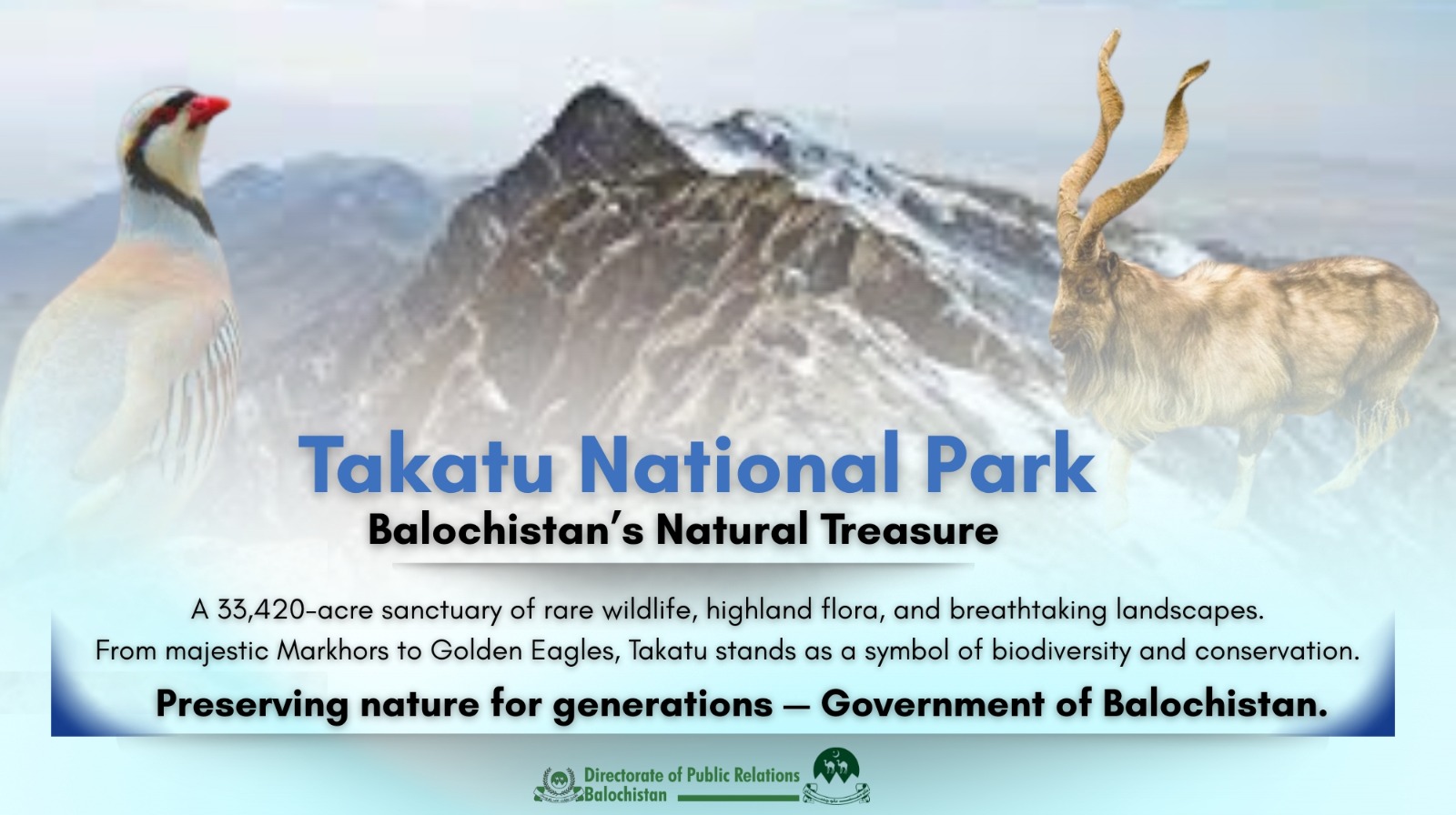
Takatu National Park, which became a National Park on 13th January 2025. The park is located in One of the most valuable ecological resources of Baluchistan in the Sulaiman Mountain Range in the northeast of Quetta covering an area of 33,420 acres that spans Quetta and Pishin districts. Additionally, the long area of Takatu National Park makes it hard to be covered with limited staff. This conservation zone is an important haven of unique flora and fauna, which is an indication of the fantastic biodiversity of the highland ecosystems of the province.
Geographical and Ecological Significance
The Loa Isai Peak is the tallest point of the park and is 3,472 meters (11,391 feet) above sea level. It is the third highest mountain in Balochistan, which has magnificent views of valleys and Rocky Mountains. The environmental diversity of Takatu Mountain, together with the natural beauty of the terrain, makes it an important location in the ecological studies and conservation as well as sustainable tourism.
Flora (Vegetation)
The flora at Takatu national park shows how life in semi-arid climate of Balochistan has been developed. Major plant species include:
- Pistacia khinjik
- Pistacia integerrima (Shin)
- Artemisia (wild shrubs)
- Wild Almond
- Ficus (Anjeer)
- Juniper
- Ephedra and other herbs, shrubs and trees of season.
These plant communities are useful in preservation of the soil, maintenance of microclimates and support of the wildlife through natural food and shelter.
Fauna (Wildlife)
The park hosts more than 500 markhors with some being rare and some being endangered species like:
- Suleiman Markhor
- Kabul Markhor
- Indian Wolf
- Red Fox
- Cape Hare
- Porcupine
- Red Lynx
- Afghan Hedgehog
- Wild Cat
- Persian Jird (Iranian Jird)
- Asiatic Jackal
- Hyena
Birds; The bird life is an added beauty to the scenery. The major bird species are:
- Chukar Partridge
- See-see Partridge
- Aquila (Golden Eagle)
- Rock Pigeon
- Hill Sparrow
Reptiles There is also the presence of reptiles like lizards, geckos, snakes and tortoises which are significant towards the ecological balance.
Conservation Measures
At the Forest and Wildlife Department, Government of Balochistan, sustainable management practices which focus on the biodiversity in the park are still in practice. Significant conservation efforts are:
- Biodiversity protection, conservation and preservation.
- Creation and upkeep of artificial water ponds where wildlife are to be found.
- Supply of emergency water supply during times of droughts.
- Frequent anti-poaching patrols against poaching to check illegal hunting.
- Field camping activities in various areas to be closely monitored.
- Local communities’ participation in the conservation and awareness of wildlife.
Such efforts are essential in preserving ecological balance and securing the survival of the endangered species over a long period.
Hardships and Challenges
Regardless of the hard work of the government of Balochistan, there are a number of challenges that still undermine efficient conservation:
- The most natural springs, ditches and ponds have been dried up due to severe drought conditions.
- There is acute shortage of drinking water to large mammals especially Markhor.
- Field employees usually transport water using donkeys and motor cycles to distant locations.
- Poor water infrastructure limits the supply of water in dry seasons.
- Illegal hunting and poaching are causing a threat to wildlife.
- The park has too much land that cannot be covered by patrolling personnel.
The Takatu National Park is an active emblem to the natural beauty and biosphere of Balochistan. Its continuous programs have ensured the Forest and Wildlife Department has been firm in its endeavors to preserve the and wildlife habitats, and to reclaim natural ecosystems, wild landscapes, and practice sustainable environmental management.
It will be through a concerted effort by the government, the local people and environmental groups that Takatu will continue to be a healthy habitat to generations yet to come.